Settings
Settings is grouped into five sections (tap the chips at the top): General, Automation, Data, Security, About.
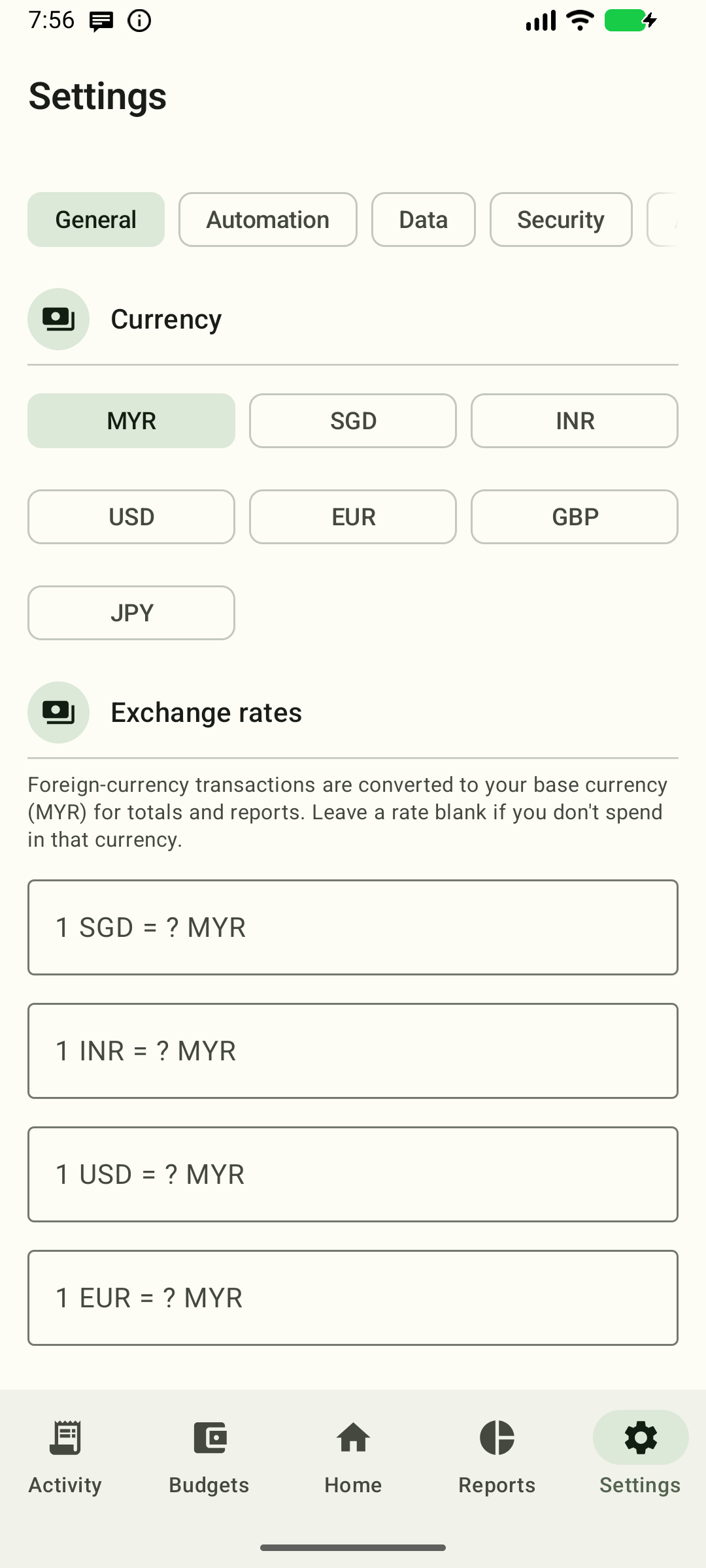
General
Currency
Pick your display currency: MYR (default), SGD, INR, USD, EUR, GBP, or JPY. The currency chips show ISO codes only (no symbols). Applies to formatting everywhere. Amounts are stored in minor units of their own currency, so changing this only changes how they're shown.
Exchange rates
If you spend in more than one currency, enter how much one unit of each
foreign currency is worth in your display currency (e.g. 1 SGD = ? MYR),
then tap Save exchange rates. Cross-currency totals on Home, Budgets,
Transactions, and Reports use these rates; leave a rate blank if you don't
spend in that currency — those transactions are then excluded from totals and
called out in a footnote.
Appearance
- Theme — System / Light / Dark.
- Dynamic color — use your wallpaper's colors (Android 12+).
Tracked bank apps
Tick/untick the bank and wallet apps to track. This takes effect immediately — unticking stops capturing that app's notifications. Untracked apps' notifications are ignored entirely.
Automation
Parse rules
AutoBudget reads each bank's alerts using small patterns — one set per app. Tap a row to open the rule editor for that app:
- Toggle the switch to enable/disable a rule (takes effect immediately).
- Expand a rule to see its pattern and settings, test it, or delete it.
- Live test — paste a sample alert and tap Parse with all rules (or Test this rule on a single rule) to see what AutoBudget would extract: amount, direction, status, and merchant.
Advanced. Rules are editable patterns, written as regular expressions. Test your changes before relying on them — if you break a rule, that bank's alerts fall back to the review queue.
Notify on capture
Toggle whether AutoBudget posts a silent notification (no sound, no popup) when it turns a bank alert into a transaction. On by default. Tapping the notification opens that transaction's detail screen. Turn it off if the tray entries get noisy.
On Android 13+ the first time you switch this on, Android asks for the "send notifications" permission — allow it or no notification will appear (transactions are still captured either way). The same prompt appears once at the end of onboarding.
Record transaction locations
Toggle whether AutoBudget captures the device location when a payment notification arrives (off by default). The location is stored encrypted on this device only and never transmitted. When on, Android asks for the location permission; after granting it, AutoBudget opens the app's Android settings page — set Location to “Allow all the time” so capture also works while the app is closed (a red hint appears under the toggle until it is set). Deny the permission and the toggle stays off. You can always add or fix a transaction's location from the editor's Location row.
Category keywords
Edit the keyword lists that auto-categorize merchants. One field appears per expense category — the defaults (Food, Groceries, Transport, Shopping, Utilities, Subscriptions, Entertainment, Health, Other) plus any custom categories you created from the Budgets tab.
- Keywords are comma-separated; a merchant containing any keyword maps to that category.
- Stored values replace defaults per category (they don't merge).
- Tap Save keywords to persist (the button enables when changed).
- User category overrides (from the transaction editor) always win over keywords.
- Renaming a custom category keeps its keywords (the stored entry is re-keyed automatically).
Data
Export
- Export CSV / Export JSON — opens the system save dialog where you pick the destination folder and file name. Rows: occurred_at, merchant, amount, currency, direction, status, category, account, source, note, parse_source, raw_json, items.
Import
- Import JSON — pick an exported JSON file. Amounts are re-parsed with their currency; duplicates are skipped (same dedupe key as live capture). You'll see how many were imported.
Offline map pack
This has its own card directly beneath the export/import card.
- Import pack / Remove — the location picker draws on an offline
basemap. A small country overview ships with the app; importing a
.pmtilespack (a single-file map archive) unlocks street-level detail. Packs are built from OpenStreetMap data — grab the dated Malaysia pack from the project's GitHub releases page. The installed pack's file name is shown in the section; Remove deletes it and falls back to the overview.
Delete all data
- Delete all data — wipes transactions and the review queue (categories, budgets, rules, and settings are kept). Confirm in the dialog.
Deleting is permanent and cannot be undone. Export first if you want a backup.
Security
See Security & privacy — app lock (PIN + biometric), auto-lock, lockout.
About
A short explainer describes what the app does, then shows which build you're running:
- Version — version name (build code), e.g.
1.2.3 (10203). - Build date — UTC timestamp of when the APK was built.
- Revision — the short git commit the APK was built from.
- Privacy policy — a link to how AutoBudget handles your data (opens in your browser).
- Support — a clickable
mailto:link for questions, support and enquiries (app-dev@zharif.myby default).
Use the version and revision when reporting a bug.